


External Validation and Comparison of Two Prediction Scores in Mild Traumatic Brain Injury
DOI:
https://doi.org/10.14740/cem5Keywords:
Mild traumatic brain injury, Clinical prediction rule, External validation, Computed tomography, Neurosurgical intervention, Emergency medicineAbstract
Background: Clinical decision rules for computed tomography (CT) in mild traumatic brain injury (MTBI) are mostly derived in high-income countries and may not transfer well to low- and middle-income settings. Two prediction scores, a clinical-based score and a model-based score, were derived from a Thai multicenter cohort. The model-based score has not been externally validated, and the two scores have not been compared in an independent population. We aimed to externally validate and compare both scores.
Methods: We retrospectively studied consecutive adults with MTBI (Glasgow Coma Scale 13–15) who underwent head CT and met at least one Canadian CT Head Rule (CCHR) criterion at a regional hospital in northern Thailand between February and April 2024. Both scores were calculated exactly as published. Outcomes were traumatic intracranial findings on CT and neurosurgical intervention within 7 days. Discrimination was assessed with the area under the receiver operating characteristic curve (AuROC) and compared using the DeLong test and bootstrap resampling. Calibration of the model-based score and diagnostic accuracy at the published cut points were also assessed.
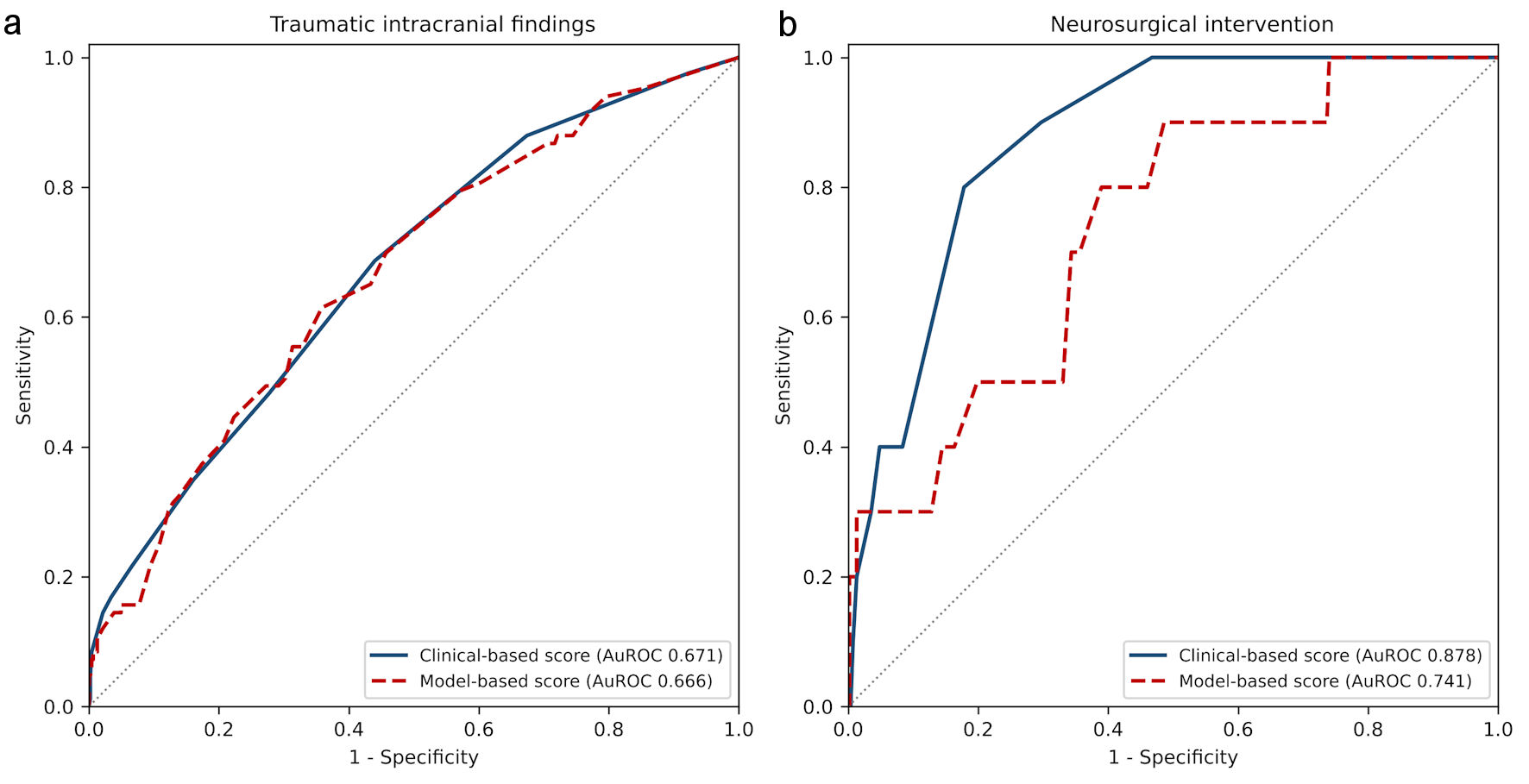
Results: Of 559 patients, 549 were analyzed; 83 (15.1%) had traumatic intracranial findings and 10 (1.8%) underwent neurosurgical intervention. For traumatic findings, the AuROC was 0.671 (95% confidence interval (CI), 0.609–0.733) for the clinical-based score and 0.666 (95% CI, 0.603–0.729) for the model-based score (P = 0.806). For neurosurgical intervention, the AuROC was 0.878 (95% CI, 0.803–0.952) and 0.741 (95% CI 0.591–0.891), respectively (DeLong P = 0.026; bootstrap difference 0.137, 95% CI, 0.034–0.283); because only 10 events occurred, this comparison is exploratory. At their CT cut points, both scores identified all 10 patients who required neurosurgery (observed sensitivity 100%, 95% CI, 72.2–100), with specificities of 30.1% and 23.9%. The model-based score overestimated risk (calibration-in-the-large −0.408; calibration slope 0.457).
Conclusions: Both scores identified every patient who required neurosurgery, but the small number of events limits the precision of this finding. Discrimination for traumatic findings was modest, and the more complex model-based score offered no advantage over the simpler clinical-based score. In this population, restricted to patients who met at least one CCHR criterion, specificity was low and the potential reduction in immediate CT eligibility was limited. Larger studies are needed.
Published
Issue
Section
License
Copyright (c) 2026 The authors

This work is licensed under a Creative Commons Attribution 4.0 International License.